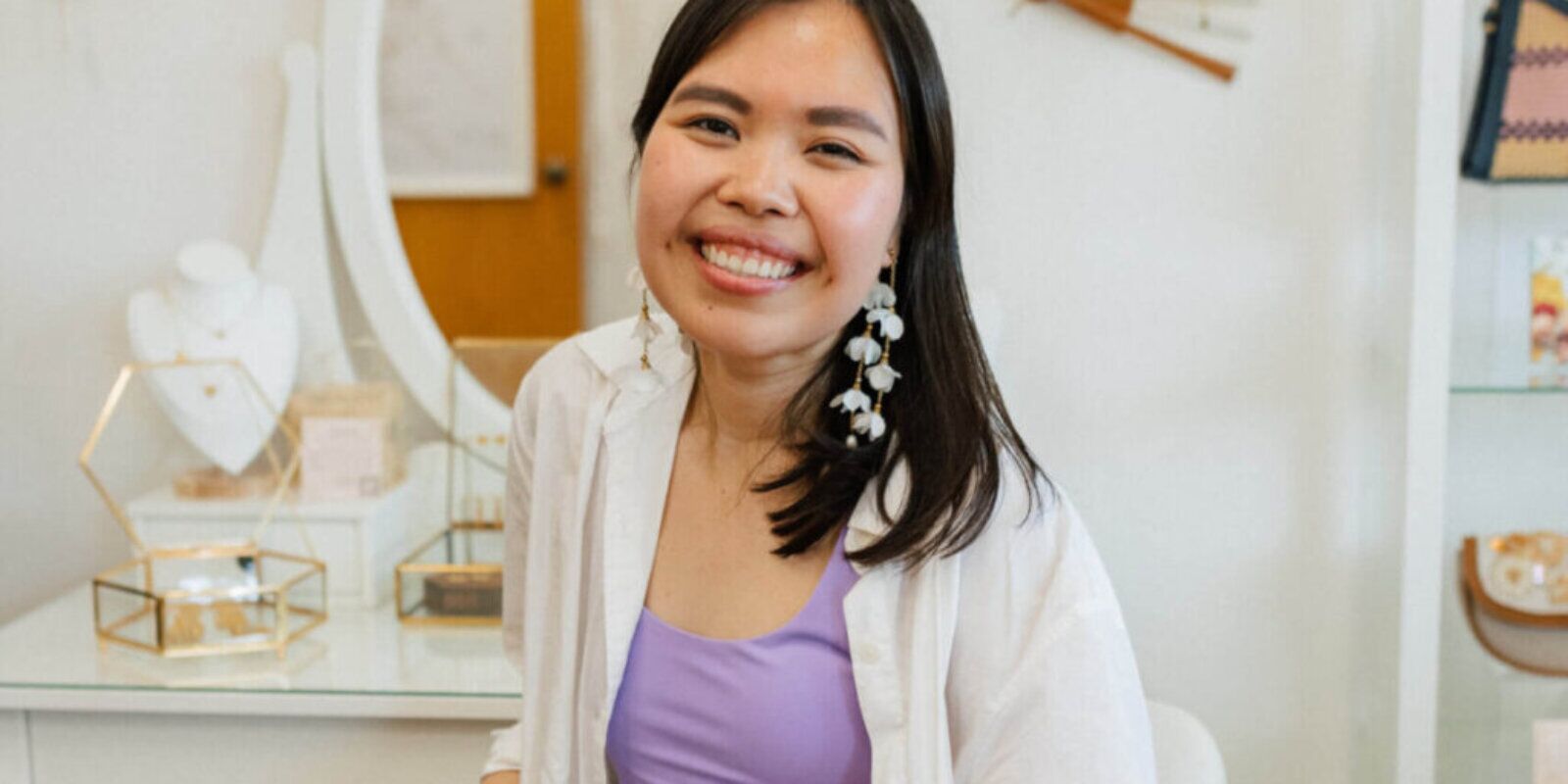
A family vacation in the Philippines sparked an idea for Cambio & Co. co-founder Gelaine Santiago: open a business that shares Filipino products with the rest of the world.
“That trip was really eye-opening because it (showed me that) there’s so much I didn’t know about the Philippines,” she said.
Santiago was born in Bulacan but immigrated to Canada when she was two.
She felt “very disconnected” from her Filipino identity and didn’t know what it meant to be Filipino.

While in the Philippines, Santiago found some “really cool” businesses that had social impact and were run by amazing people.
“For me as a Filipino, (I was so) proud to know these businesses exist,” she said, and she sought to open a business of her own in Canada.
Opening Cambio & Co.
Before Cambio & Co. became the go-to brand for Filipinos craving “a piece of the Philippines,” Santiago was told by fellow Filipinos that selling Filipino-made products was a bad idea.
“When we launched in 2015, it was initially called Cambio Market.
“(We were told) no one’s going to buy products from Philippines: that it’s too cheap, the the quality is bad,” she said.
Santiago and co-founder Jérôme Gagnon-Voyer launched Cambio Market as a broader artisan marketplace, with products from Peru, Uganda, Guatemala and the Philippines.
But growth stalled until they rebranded in 2018 to carry products that were proudly designed and handcrafted in the Philippines.
The pivot led to traction that felt “almost immediate” and built a wave of “really heartfelt” community response.
The “Pandemic Boom” Twist
Cambio & Co. didn’t just survive the pandemic—it hit its biggest growth spurt when travel shut down and Filipinos started craving home in wearable form.
Santiago credits the growth to e-commerce timing and fulfilling people’s emotional need to connect to their culture.
The pandemic saw people looking for “a piece of the Philippines” and deeper self-discovery, which matched Cambio’s mission.
Challenges
It wasn’t all smooth sailing for Cambio & Co. after the pandemic.
Working with Filipino artisans taught Santiago the realities of infrastructure, climate risk, and capacity-building.
Santiago emphasized that artisan partnerships are complex everywhere, but compounded by Philippine realities.
“The infrastructure is not there,” she said, adding that materials like pearls became extremely expensive and typhoons routinely disrupted production and shipping.
She also pointed to a skills-investment gap: artisans have “generational skills,” but need support to meet export consistency.
A Decade of Filipino Heritage
After a decade of proving the naysayers wrong and building a community-fueled business, Santiago announced the closure of Cambio & Co. in February 2026.
“The immediate, easy answer was tariffs, which made it really, really impossible to keep going,” said Santiago.
Her advice to other diaspora founders is to “be clear on your ‘why’ and commit for the long haul”.
Even as Cambio & Co. closed, she said they tried to exit responsibly by connecting artisan partners to a list of other retailers, and “to hold these relationships with care.”
“I didn’t know anything before. Cambio & Co. helped me grow up as a person, but also as a Filipino,” she said.
Asked what’s next for Santiago, she said she is launching a business called Founding Possibilities.
“It is a growth studio and a coaching company that specializes in helping justice-driven BIPOC founders build seven-figure businesses that lift up their communities,” she said.