
Five years ago, I packed my bags and moved from Nova Scotia to Ontario to pursue my PhD.
Being away from my family, friends, and comfort zone urged me to (re)create familiarity.
One way I did that was by trying my hand at cooking Filipino dishes.
I first learned how to cook Filipino food by helping my mom cook for our family during the pandemic.
Cooking became a way for my mom and I to spend quality time together.
It also became my way of reconnecting with my Filipino heritage.
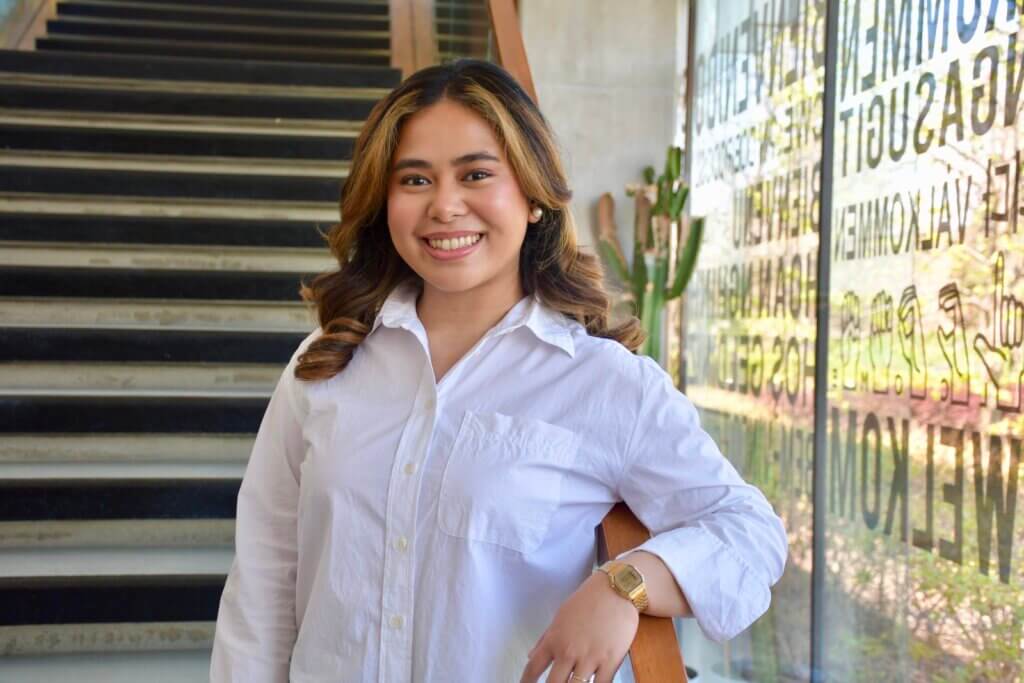
When I started living on my own in Ontario, I felt like a fish out of water.
I had a roommate who was a complete stranger to me and with whom I had to share a kitchen.
We cooked different dishes and at different times in our tiny kitchen.
Because of that, I resorted to making quicker, ‘grab-and-go’ meals for convenience, rather than the meals I usually enjoy (Filipino food).
After a few months of cycling through sandwiches and wraps, the Filipino in me yearned for rice and ulam (entree).
One day, I decided to push myself out of my comfort zone and try to recreate the dishes I learned from my mom.
Eventually, with baby steps, I learned to cook Filipino food on my own.
Don’t get me wrong, a lot of it was trial and error at first, including many FaceTime calls with my mom while cooking and even embarrassing moments like setting off the fire alarm more than once—oops!.
But I persisted.
Five years later, I’m happy to share that I have a humble list of Filipino dishes that I feel I have mastered.
These dishes have gotten me through, and continue to get me through, graduate studies, especially when I feel homesickness and, at the same time, a desire to reconnect more deeply with my Filipino heritage.
Chicken Adobo
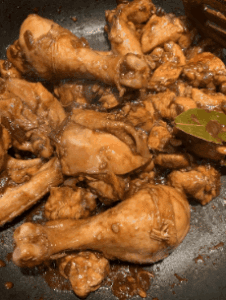
Who doesn’t love a savoury chicken dish?
What makes this dish special is the flavour of the chicken produced from simmering it in soy sauce and vinegar.
Oh, and don’t forget the dahon ng laurel (bay leaf).
Some like their adobo with whole black pepper, although I prefer the black pepper ground.
If chicken isn’t enough for you, you can even add pork belly to make chicken and pork adobo.
Finally, don’t forget to serve it on a bed of hot white rice.
Pork Giniling (Filipino-Style Picadillo)
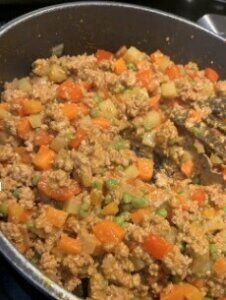
Giniling sparks memories of being in my grandparents’ house because this is a dish my lola (grandmother) makes often.
What I love about this dish is all the vibrant colours and flavours from the sweet peas, potatoes, carrots, and bell peppers, mixed with the savoury taste of ground pork.
This is also best served with a bowl of hot rice.
Optional: you can even fry a saging na saba or plantain for a sweet bite.
Filipino-style spaghetti
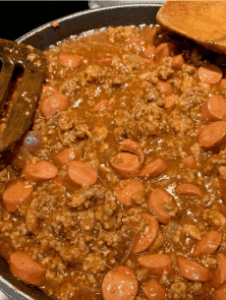
This Filipino-style spaghetti transports me to children’s parties at Jollibee.
Some might consider hotdogs in spaghetti an unusual combination.
Some might also find it strange to eat such sweet spaghetti! But to me, those elements are what make Filipino-style spaghetti unique.
This is also a hit with many kids because it’s sweet.
Longganisa (cured sausage)
I recommend longganisa brands such as Pampanga’s Best, Baguio, or Siwin.
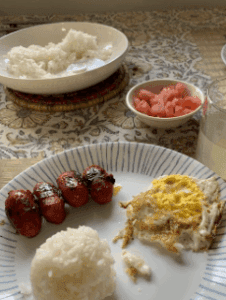
Eating this garlicky, sweet, and spicy combination of longganisa makes me feel like I’m in a karinderya (small eatery).
My favourite way to eat this is by pairing it white rice—preferably garlic rice—fried egg, and diced tomatoes.
In short, I like it as longsilog: longganisa, sinangag (garlic rice), and itlog (egg).
Sometimes, I like to dip the longganisa in vinegar as well.
Finally, to add that Filipino flair, I enjoy this dish the most when there is calamansi juice or lemonade on the table.
 Giana Tomas is a learner, writer, community partner, and scholar who advocates for wellness of migrant and diasporic communities. Born and raised in Manila, Philippines, she is dedicated to learning and sharing stories about how individuals and families from the Philippines draw connections to ‘home’ when they migrate. To connect with Giana, visit @giana_tomas on Instagram.