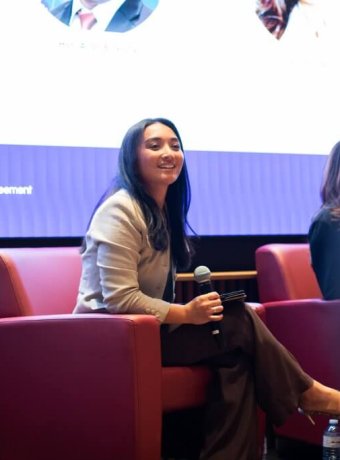
After years of rebuilding her legal career in Canada, Filipino Canadian lawyer Maria Melissa Briones is preparing to receive international recognition as one of the 2026 Global FWN100 Most Influential Filipina Women in the World at a ceremony in Monaco on Nov. 17.
Briones, founder and CEO of Northam Law Corporation in British Columbia, is being recognized for her professional accomplishments and leadership as a Filipina working in Canada’s legal industry.
For Briones, the recognition represents both a personal milestone and an opportunity to connect with other Filipina leaders around the world.
“I was very happy,” Briones said.
“I knew I was being nominated and it took some time for the decisions to come out, so I was also stressed.”
She admitted questioning whether she belonged among previous recipients whose accomplishments had gained international attention.
“There were periods of doubt and fear. And when I learned about it, I felt a sense of validation,” she said.
Those doubts eventually gave way to excitement about joining a network of women who have overcome professional barriers.
“Going into a sisterhood of these women who help shape the worlds that we are in, who are continually breaking glass ceilings,” she said.
“They’re such inspiration to me.”

Starting over in Canada
Before pursuing law, Briones worked at Philippine television network ABS-CBN, managing actors, directors and executive producers.
Although she enjoyed the experience, she began looking for a career that would challenge her intellectually.
She applied to both business and law programs at the University of the Philippines before choosing to study law.
Briones began practising in the Philippines in 2007, but her professional journey changed when she immigrated to Canada in 2011.
“When I started in Canada, I was very naive,” she said.
“I thought that my experience, because I was a lawyer, I’ll easily go into the legal field here.”
Despite her education and experience, she struggled to find opportunities without Canadian legal credentials.
She recalled approaching a Filipino paralegal for help securing an entry-level position at a law firm, even offering to work as a legal assistant or receptionist.
Her request was declined.
“I had the training, the experience, the hours, the education,” she said.
“But since I did not have any Canadian experience or education in the legal field, I couldn’t go that route.”
An opportunity eventually came through Organika Health Products Inc., where she was hired as a human resources manager.
The company’s founder, Thomas Chin, recognized her legal background and gave her additional responsibilities as a contracts manager.
“He gave me that encouragement, making me feel that he recognized me, saw my potential and knew what I could do,” she said.
Briones eventually completed eight accreditation examinations, the Professional Legal Training Course and bar examinations, before becoming a lawyer in Canada in 2019.
Her pursuit of education continued even after establishing her practice.
In June 2026, she completed a master of laws degree at the University of Washington, travelling across the Canada-U.S. border twice a week while balancing work and family responsibilities.
“There’s a part of me that still wants to learn more with the intent of giving more to my clients,” she said.
For Briones, continuing her education is essential to providing responsible legal services, particularly as she explores opportunities in the United States.
“There’s a cure for ignorance, I think,” she said.
“And that would be to try to learn more.”
Challenging invisibility in the legal profession
While Briones has achieved significant professional success, she believes Filipino professionals continue to face barriers to leadership and recognition in Canada’s legal industry.
Briones said only one Filipino lawyer in British Columbia holds the prestigious King’s Counsel designation, which she sees as an example of the community’s lack of representation in the legal profession.
“We’re invisible, and that is kind of what I’ve had to face,” she said.
Briones believes professional networks and institutional support play important roles in determining who receives opportunities for advancement.
She also sees the experience of being underestimated as something Filipino professionals can turn into motivation.
“When you’re underestimated, you kind of over-deliver,” she said.
“And when you over-deliver, you are seen. And when you’re seen, you are heard.”
For her, greater representation requires Filipino professionals to support one another and build stronger networks within their industries.
“There should be more of us,” she said, calling for more Filipino-owned legal practices and greater support for immigrant professionals.
Briones said she has received support from organizations including the Rotary Club of Vancouver Mountainview and the University of the Philippines Alumni Association in British Columbia.
However, she believes the community could accomplish more through stronger collaboration.
“We kind of lift each other up, but as a power, we’re not cohesive,” she said.
Bringing Filipino identity into legal practice
Briones also considers her Filipino identity an important part of how she connects with clients.
Many of the people she serves are Filipino families, home buyers and business owners navigating legal processes that can feel unfamiliar or overwhelming.
“We speak in the vernacular. We speak in the Filipino language in ways that they understand,” she said.
When assisting Filipino clients purchasing their first homes, she sometimes references familiar traditions, including bringing rice, water and religious items into a new home.
She believes these cultural connections help clients feel understood during major life decisions.
“They feel better about the purchase,” she said.
“They feel more informed about what they’re going into.”
Her approach also extends to family law, where she encourages clients to consider the emotional and financial consequences of disputes.
“I try to communicate that winning is not everything, that sometimes you kind of have to compromise to have peace of mind,” she said.
Using recognition to strengthen community connections
Beyond her legal career, Briones hopes to use her Global FWN100 recognition to create opportunities for other Filipina professionals and address challenges facing Filipino Canadian families.
One initiative she is developing is YOLOdex, short for You Only Live Once Rolodex, a proposed application intended to encourage families to maintain stronger connections with elderly relatives.
Through her wills and estates practice, Briones said she has encountered seniors experiencing loneliness, family conflict and isolation.
Her idea involves sending reminders encouraging relatives to check on their parents and remember meaningful details about their lives.
“Every week, call your mom,” she said, describing one possible reminder.
“I think that family connection is what will make us happy.”
Briones also plans to nominate other accomplished Filipinas for future Global FWN100 recognition.
She hopes the relationships she builds with fellow award recipients in Monaco will help create more opportunities for Filipino women.
“We already have the numbers, the strength, the abilities to do more,” she said.
Briones encourages younger Filipina professionals, particularly newcomers to Canada, to continue learning and seek mentors who can help them navigate unfamiliar professional environments.
“Don’t listen to people who say you can’t do it. Because you can,” she said.
Reflecting on the lessons of her own journey, Briones offered a message about resilience and the strength of Filipino communities.
“Be resilient. Your roots, the sun is within you and it’s going to get you through the darkest nights,” she said.
“You have your community around you. It is a pretty strong community,” she said.
“It is a very wise community and it will support you, empower you if you need them to be there to guide you.”
 Luis Miguel De Castro is a Changing Narratives Fund-Local Journalism Initiative reporter at Mabuhay Canada and a journalism graduate at Humber Polytechnic in Toronto. Originally from the Philippines, he is passionate about community storytelling, multimedia journalism, and amplifying Filipino voices through meaningful local coverage.