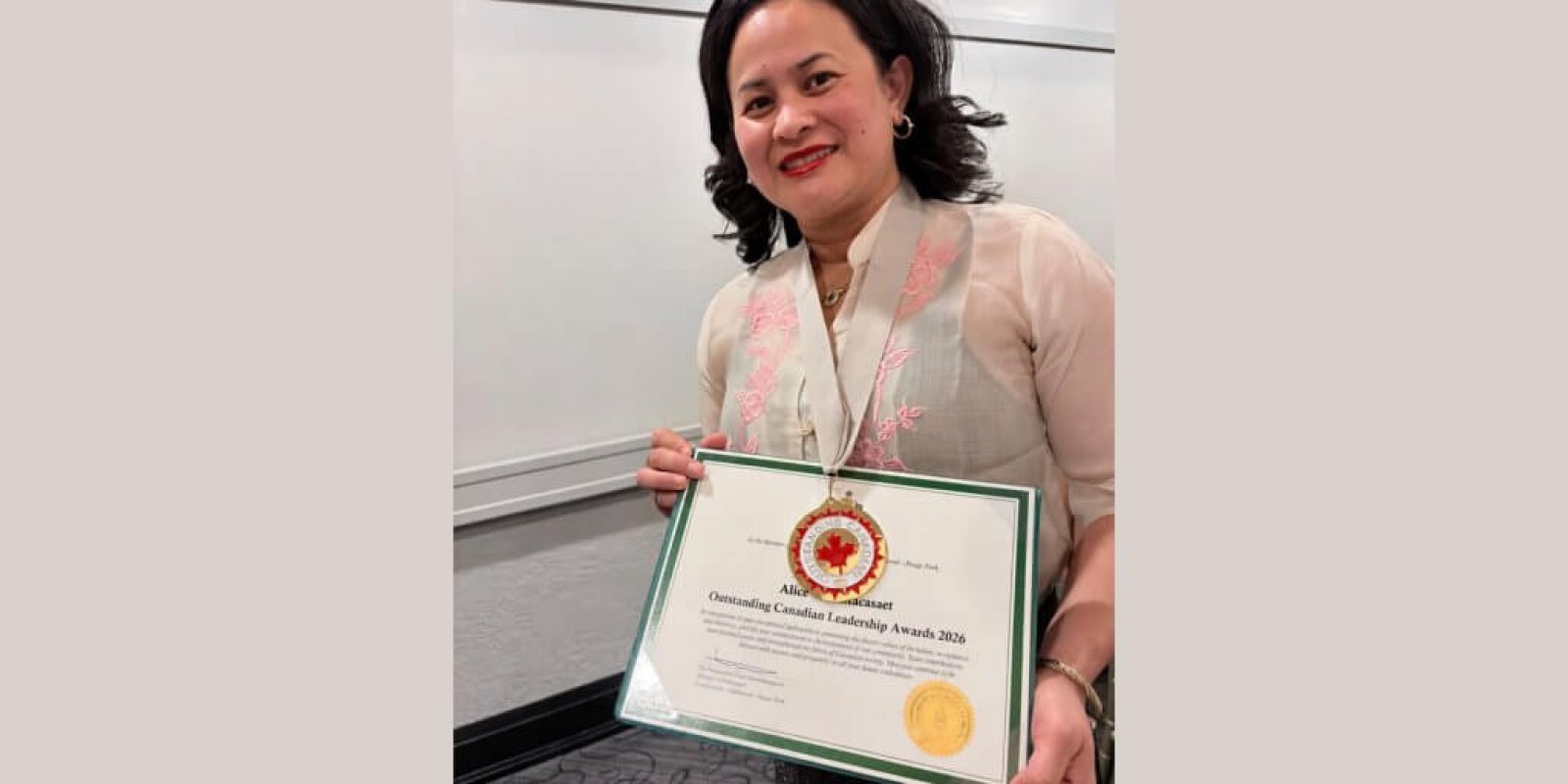
Filipina Canadian engineer Alice Macasaet has received the 2026 Outstanding Canadian Community Leadership Award for her efforts to mentor Filipino professionals and help internationally trained engineers build careers in Canada.
Now a licensed professional engineer working at the Toronto Transit Commission (TTC), Macasaet draws on her own experience of rebuilding her career in Canada to help fellow Filipinos navigate similar challenges.
For Macasaet, the recognition is also a reminder of the people who helped her when she was starting over.
“Personally, this award reminds me of the people who helped me find my footing in Canada,” she said.
“It inspires me to give back, especially to my fellow Filipinos who are building their careers here.”
Leaving a career behind to start again
Before arriving in Canada in 2018, Macasaet worked for more than 10 years as a supervisory control and data acquisition (SCADA) engineer at Meralco, one of the Philippines’ largest electricity distribution companies.
Her decision to move to Canada was driven by family rather than professional ambition.
“I came to Canada to support my family, and along the way I found a way to build on the engineering career I had started back home,” she said.
The move meant leaving behind an established career and investing much of her savings in a new beginning.
Macasaet enrolled in the energy systems engineering technology program at Centennial College while helping care for her sister’s children.
Balancing her studies with family responsibilities left little room for paid employment.
“I gambled my earnings for 10 years for a chance to be here,” she recalled during an interview.
After graduation, she joined an engineering consulting firm in Ontario, designing overhead and underground electrical distribution systems.
Although the field was familiar, she had to adapt to Ontario’s engineering standards and construction practices.
Rather than abandon her professional background, Macasaet pursued additional credentials and sought guidance from engineers who had already established careers in Canada.
She also earned a Project Management Professional credential, building on her previous experience in the Philippines.

Finding opportunity through community
Macasaet credits professional networking and mentorship with helping her navigate an unfamiliar industry.
She joined Filipino-Canadian professional organizations, including the Association of Filipino-Canadian Engineers and United Filipino Professionals of Canada, where she connected with experienced engineers and learned about licensing requirements.
What began as a way to develop her own career gradually became an opportunity to guide others.
“My turning point was meeting Filipino engineers who had built successful careers in Canada and were willing to share what they had learned,” she said.
Their encouragement inspired her to become more involved in community organizations and offer similar support to newcomers.
Through the organizations, Macasaet began sharing information about professional licensing and employment opportunities with internationally trained engineers.
She has also volunteered in mentorship activities with ACCES Employment, extending her community involvement to professionals from different backgrounds.
Macasaet said seeing the people she has supported reach important milestones has become one of the most rewarding parts of her work.
“Some became permanent residents, others earned their professional licences, and others found jobs where they could use their engineering experience,” she said.
For Macasaet, those achievements reflect the importance of creating opportunities for people whose qualifications and experience may not immediately translate into employment in Canada.
“Seeing someone get back to the work they trained for is one of the most rewarding parts of my community involvement,” she said.

A long road to professional recognition
Despite her growing professional network, Macasaet’s journey toward becoming a licensed engineer in Canada was far from straightforward.
Financial pressures and uncertainty surrounding her career tested her determination.
At one point, she considered returning to the Philippines.
“Back in 2024, I almost decided to go back to the Philippines,” she recalled.
A turning point came in December 2024, when her professional engineering application progressed and she was offered an interview as part of the licensing process.
Although she faced a period without employment, the unexpected break allowed her to concentrate on preparing for the assessment.
She successfully completed the interview, received an exemption from technical examinations and obtained her professional engineering licence in Ontario in April 2026.
The achievement, alongside securing permanent residency, opened new professional opportunities.
Macasaet said she had deliberately prioritized professional development over higher-paying positions that might have delayed her long-term goals.
“Sometimes it really takes time,” she said.
Her persistence eventually led to a position in the TTC’s Renewable Energy Programs, marking another milestone in a career she had once feared leaving behind.
Helping Filipino engineers overcome barriers
Macasaet believes internationally trained Filipino engineers continue to face challenges entering Canada’s engineering and construction industries.
“When you’re settling in a new country, working, and supporting your family, it can be hard to set aside money for licensing costs and time to work on your application or build a professional network,” she said.
Her own licensing journey benefited from conversations with Filipino engineers across Canada who shared practical advice about their applications.
Macasaet said those connections helped her understand how to present her previous engineering experience to meet Ontario’s licensing requirements.
“Having people I could turn to for constructive feedback gave me the confidence to keep moving to become a professional engineer,” she said.
She hopes other internationally trained professionals can benefit from similar guidance through mentorship programs and professional organizations.
Macasaet also believes Filipino engineers remain underrepresented in leadership positions across Canada’s engineering and construction sectors.
“There’s room for more Filipino professionals in leadership roles across engineering and construction,” she said.
She added that recognizing international experience and providing opportunities to lead projects could help Filipino professionals advance in the industry.
Success measured through service
Macasaet’s experiences have shaped her understanding of perseverance and the importance of pursuing professional goals while supporting family.
She acknowledged that family responsibilities can sometimes change the pace of a person’s career, particularly for women working in engineering.
“There were times when I had to plan my next step around what my family needed,” she said.
Today, her community involvement remains closely connected to the challenges she once faced as a newcomer.
Her advice to newcomers is to identify their career goals and reach out to people who have already travelled a similar path.
“You can start with a simple question about how they got into their role,” she said. “Those conversations can help you make better decisions about where to spend your time and keep you going when the process feels long.”
 Luis Miguel De Castro is a Changing Narratives Fund-Local Journalism Initiative reporter at Mabuhay Canada and a journalism graduate at Humber Polytechnic in Toronto. Originally from the Philippines, he is passionate about community storytelling, multimedia journalism, and amplifying Filipino voices through meaningful local coverage.