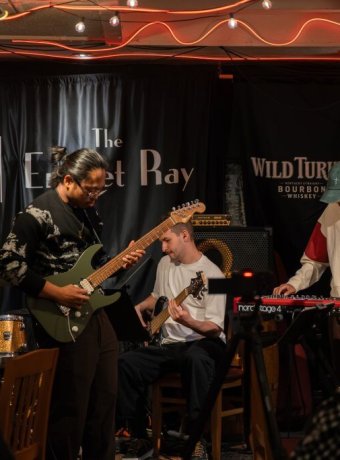
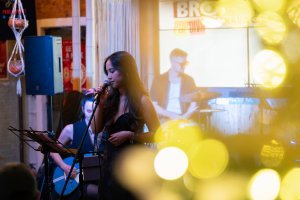
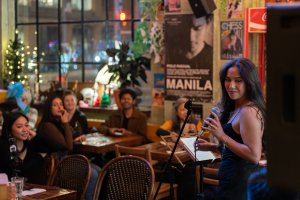
Filipina Canadian performer Hazel Wallace brought Broadway hits, pop anthems and a celebration of Filipino artistry to Makilala on Nov. 12, marking her first solo show since moving to the city to pursue a career in entertainment.
The Broadway Pop Diva Extravaganza, which began at 8:30 p.m., was organized by Dante Paolo De Real through Pagsasama.
The event brought together guests for an evening of live music, Filipino food and a lively atmosphere celebrating local talent.
The night began with performances by singers TONIE and Chloe Rondeau before Wallace took the stage.
For the Winnipeg-born singer, actress, and writer, the evening was a chance to celebrate the community that shaped her musical journey.
“No matter where I am in the world, Filipinos always have my back,” Wallace said.
Since moving to Toronto a year ago, Wallace has spent much of her time exploring opportunities in musical theatre, television, and music while reconnecting with the Filipino artistic community.
Her performances have included working with Filipino cultural groups and touring with the Filipino comedy ensemble Tita Collective.
Behind her growing career is a journey shaped by her Filipino roots and the community that inspired her to pursue a life in the arts.

Finding her voice between two cultures
Wallace grew up in Winnipeg’s Maples neighbourhood, often called Little Manila, surrounded by Filipino families, music and celebrations.
With a Filipina mother and a white father, she said Filipino culture was deeply embedded in her upbringing, particularly through music.
“It felt very normal to learn music in a celebratory way, with your intuition, with feelings, and with passion,” she said.
Although music was always part of her life, pursuing it professionally was a different story.
Wallace recalled watching talented Filipino musicians eventually choose more financially stable careers.
She struggled to imagine following a different path.
Her perspective changed when she saw Filipino performers from Winnipeg succeeding on major stages.
“Maybe I can do that too,” she said.
Wallace eventually earned a bachelor of music in classical voice performance from the University of Manitoba, but entering a predominantly Western classical music environment brought unexpected challenges.
For the first time, she became conscious of how differently her Filipino upbringing had shaped her relationship with music.
“All of a sudden, I stood out in a way that I didn’t realize I could,” she said.
Rather than separating her cultural background from her formal training, Wallace began finding ways to bring them together.
She performed Filipino music with Winnipeg’s Musica choir alongside the Winnipeg Symphony Orchestra and later joined Ma-Buhay! A New Musical, a production centred on Filipino experiences.
Those opportunities helped her recognize that her heritage was not something she needed to set aside to succeed.
Creating stories beyond stereotypes
Wallace wants to see Filipino artists take greater control over how their stories are told in Canada’s entertainment industry.
She believes meaningful change also requires Filipino artists to become writers, producers and decision-makers behind the scenes.
“I want to see Filipinas just entering rooms without having to justify why they’re there,” she said.
Her perspective is also shaped by her experience as a mixed-race performer.
Wallace acknowledged that her experiences differ from those of other Filipino artists, particularly when people make assumptions about her identity based on her appearance or surname.
She described sometimes feeling caught between cultural spaces, even when others welcomed her.
“It’s this thing of having to constantly defend which room I’m in, whether it’s a white room or a Filipino room,” she said.
That complexity has influenced her approach to storytelling.
At 19, Wallace helped create, write and produce Maria and the Mennos, a Filipino-Mennonite sitcom.
The independent production gave emerging performers and crew members opportunities to gain experience through stories exploring cultural relationships familiar to Manitoba audiences.
Wallace said she only fully realized the show’s impact when Filipino women approached her at community events, telling her that its characters reflected their own marriages and families.
The experience reinforced her belief that culturally specific stories can connect with audiences through humour.
“Comedy always has to come from a sense of truth and honesty,” she said.
She added that humour can make difficult conversations about identity and cultural differences more approachable.
The community behind the performer
Wallace credits much of her development to Filipino artists and mentors who invested in her potential.
While working on Ma-Buhay!, she participated in free training programs that helped young Filipino performers develop professional skills.
She said those opportunities were particularly important because not every aspiring artist has access to expensive lessons or industry connections.
“Without those training programs, I would be so far behind my white counterparts,” she said.
Her work also earned her the 2023 Golden Balangay Award for Excellence in Music and Entertainment.
At 21, Wallace initially questioned whether travelling to Edmonton for the ceremony was worth the expense.
Receiving the award became a turning point, particularly as she was uncertain whether performing could become a sustainable career.
The recognition reassured her that her talent and hard work were gaining recognition within the Filipino-Canadian community.
Today, she believes mentorship and accessible arts education remain essential for emerging Filipino performers.
“Navigating this whole industry with no one to guide you, you’re just throwing everything into an abyss,” she said.
She hopes more young artists will have access to free training, affordable performances and experienced mentors who can help them navigate the industry.

A stage to call their own
Wallace’s performance at Makilala brought her journey back to the community that first encouraged her love of music.
The show combined her enthusiasm for Broadway and pop with the celebratory spirit of Filipino karaoke gatherings.
For Wallace, Filipino-owned venues offer artists places to experiment, connect and feel that they belong.
“We need a meeting space, we need a common space not only for our community, but to invite others into it,” she said.
She believes those environments can encourage emerging performers to embrace their identities and pursue opportunities they might otherwise consider out of reach.
“A stage is a sacred space. A rehearsal room is a sacred space,” she said.
As Wallace continues building her career in Toronto, she hopes her work will inspire younger Filipino-Canadian artists to pursue their ambitions without feeling limited by expectations.
Her message to the next generation is simple: courage does not require the absence of fear.
“I hope that it encourages and empowers young Filipinos, young artists, to be so stubbornly fearless,” she said.
 Luis Miguel De Castro is a Changing Narratives Fund-Local Journalism Initiative reporter at Mabuhay Canada and a journalism graduate at Humber Polytechnic in Toronto. Originally from the Philippines, he is passionate about community storytelling, multimedia journalism, and amplifying Filipino voices through meaningful local coverage.