
For Filipino internationally educated nurses (IEN), the road to practising in Canada can come with a price tag of thousands of dollars.
Mark Gravoso of the Filipino IENs Society of Canada said many Filipino nurses arrive with years of clinical experience, only to find themselves struggling to have their qualifications recognized.
Some arrive with experience not only in the Philippines but also in other countries, bringing knowledge acquired through years of working in different health-care systems.
“We have decades of experience, we come from different countries, and yet, our credentials are not recognized. It’s sad to say,” Gravoso said.
Their struggles reflect a broader challenge within Canada’s health-care workforce.
According to a 2025 study by Statistics Canada, Filipino women accounted for 43 per cent of internationally educated nurses.
They are among working-age immigrant women with foreign nursing education in 2021, representing the largest racialized population group in that category.

The financial weight of a nursing licence
For many internationally educated nurses (IENs), the expenses begin long before they enter a Canadian hospital.
In Ontario, applicants must satisfy several registration requirements established by the College of Nurses of Ontario (CNO), including educational qualifications, language proficiency, evidence of recent nursing practice and registration examinations.
As of 2026, the CNO charges $433 for a general class registration application and $40 for a jurisprudence examination.
Those fees are set to increase to $454 and $42, respectively, in 2027.
However, these expenses represent only a fraction of the potential financial burden.
Gravoso estimates that some IENs may need nearly $3,000 for licensing-related expenses.
Costs approach $4,000 when additional examination preparation and review materials are factored in.
Drawing from his own experience, Gravoso recalled spending $1,500 on a clinical competency assessment and another $1,000 on preparatory sessions.
He also spent more than $1,000 on resources to prepare for the National Council Licensure Examination (NCLEX).
“It’s costly. This is like the hidden cost that many Filipino nurses are facing,” he said.
The expenses can increase further when applicants need to retake examinations or undergo additional assessments.
For nurses settling in Toronto, these expenses are compounded by the city’s high cost of living.
According to data released by Statistics Canada on Nov. 19, Toronto recorded the second-highest average rent in Canada at $2,650 per month in the second quarter of 2026, behind Vancouver.
The agency also found that 40 per cent of renters across Canada who had moved within the previous two years were living in unaffordable housing in 2024.
These renters spend more than 30 per cent of their household income on shelter.
For internationally educated Filipino nurses who have yet to return to their profession, balancing everyday living expenses with the cost of obtaining a nursing licence can make rebuilding their careers even more challenging.
Working to survive rather than practise
Many Filipino nurses also find themselves working outside their chosen profession to make ends meet.
Gravoso said some take on multiple jobs to finance their applications while supporting their families in Canada and the Philippines.
“They need to survive. They need to find means to pay for their preparation, for their registration,” he said.
Research published by Statistics Canada in October 2025 highlights the extent of this professional disconnect.
While 72 per cent of Filipino IENs worked in health care, only 38 per cent held positions that matched their educational attainment.
The study found that many IENs were employed in roles below their qualifications, including as caregivers and orderlies.
Even after obtaining their licences, securing employment remains a challenge.
According to the College of Nurses of Ontario’s 2025 nursing statistics report, 22 per cent of internationally educated registered nurses renewing their licences for the first time were still seeking nursing employment.
In comparison, only 10.9 per cent of their Ontario-educated counterparts were still looking for work.
For some Filipino nurses who immigrated through caregiver pathways, Gravoso said the time spent working outside nursing can also complicate their ability to demonstrate recent clinical experience.
In Ontario, applicants are generally required to demonstrate nursing practice within the previous three years or otherwise satisfy the regulator’s evidence-of-practice requirement.
Gravoso acknowledged the importance of maintaining professional standards but questioned whether some assessment procedures unnecessarily prolong the return of qualified nurses to the workforce.
“The public protection and administrative efficiency must go hand in hand,” he said.
Progress amid persistent barriers
Despite these challenges, recent changes in Ontario have offered some relief to IENs.
Through a temporary reimbursement program administered by Ontario Health, eligible nurses can recover certain registration-related expenses incurred between April 1, 2026, and March 31, 2027.
The program covers eligible application fees, language proficiency tests, registration examinations and membership fees, among other expenses.
Gravoso welcomed the initiative and expressed hope that other provinces would introduce similar financial assistance.
He also commended the CNO’s decision to accept more educational credential assessment providers, giving IENs greater flexibility in having their qualifications evaluated.
However, lengthy processing times remain a concern.
Gravoso said he is currently advocating for a group of IENs who have been waiting nearly a year for decisions after submitting documents to demonstrate their nursing practice.
He hopes regulators can establish clearer timelines to prevent applicants from facing prolonged professional and financial uncertainty.
Finding strength in community
When Gravoso immigrated to Canada in 2017, he immediately began searching for employment without seeking support from a community that understood the challenges he faced.
Years later, those experiences have become the foundation of his advocacy.
Through the Filipino IENs Society of Canada, Gravoso helps fellow nurses navigate licensing requirements and encourages them to continue pursuing their profession.
He advises aspiring newcomers to familiarize themselves with provincial registration requirements and gather the necessary documents before leaving the Philippines.
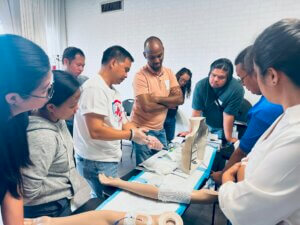
He also encourages nurses working in temporary jobs not to lose sight of their professional ambitions.
“It’s okay to have a survival job, but they have to make sure that that’s only a temporary position,” he said.
“They have to upgrade themselves and they need to find a community.”
For Gravoso, helping IENs return to practice is also about ensuring Canada benefits from the knowledge and expertise they bring.
Having experienced the difficulties of rebuilding a career in a foreign country himself, he now uses his journey to remind others that their circumstances do not have to be permanent.
“The struggle is real when you come here in Canada,” he said.
“Once you get your license, you work on it; it will be worth it.”
 Luis Miguel De Castro is a Changing Narratives Fund-Local Journalism Initiative reporter at Mabuhay Canada and a journalism graduate at Humber Polytechnic in Toronto. Originally from the Philippines, he is passionate about community storytelling, multimedia journalism, and amplifying Filipino voices through meaningful local coverage.