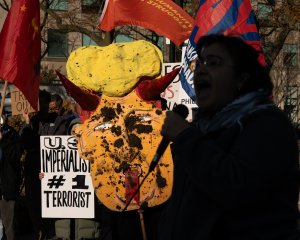
Filipino groups gathered outside the U.S. Consulate in Toronto on Nov. 18 to protest U.S. President Donald Trump’s visit to the Philippines and raise concerns over the Pax Silica initiative.
The demonstration, held at the Pillars of Justice along University Avenue, formed part of a global day of action against the initiative, with similar protests taking place in Ottawa, Vancouver and the Philippines.
While the Philippine government has promoted the initiative as an opportunity for economic development, protesters expressed concerns about its potential environmental consequences and the displacement of local communities.
Kim Garcia, coordinator of Bayan Toronto, said Filipinos overseas have a responsibility to remain informed about developments affecting their home country.
“We are very much connected to the struggle in the Philippines even though we are here now,” she said.

Concerns over land and livelihood
Pax Silica is a U.S.-led international initiative aimed at securing supply chains for critical minerals, semiconductors and artificial intelligence (AI).
The Philippines joined the initiative in April, with plans to establish a roughly 1,620-hectare industrial hub within the Luzon Economic Corridor in New Clark City, Tarlac.
According to the U.S. Department of State, the proposed development aims to attract foreign investment, strengthen technology manufacturing and establish more secure global supply chains.
However, Garcia said economic development should not come at the expense of communities whose livelihoods depend on the land.
“What is opportunity if it comes at the cost of thousands and thousands of Filipinos?” she said.
Among the organization’s primary concerns are the potential displacement of Indigenous communities and farmers, as well as the environmental consequences of critical mineral extraction.
“We are really concerned about just how much people’s basic land and livelihood will be destroyed in the process,” Garcia said.
Philippine President Ferdinand Marcos Jr., meanwhile, has expressed support for the initiative, saying it could generate high-quality employment opportunities and position the Philippines as a key player in the global AI industry.
Although Trump’s visit renewed attention on Pax Silica, no framework agreement for the proposed industrial hub was signed during his time in Manila.
A personal connection to the land
For protest attendee Kate Calimag, the concerns surrounding Pax Silica are deeply personal.
Coming from a family of farmers, Calimag said reports of the potential displacement of agricultural and Indigenous communities motivated her to join the demonstration.
“Just as simple as hearing that many Indigenous people and farmers will be displaced, that already touched me,” she said.
Calimag first learned about the initiative through Philippine television news before following reports of Indigenous communities travelling to Manila to voice their opposition.
She said her greatest concern is the possibility of Indigenous peoples losing access to ancestral lands that have sustained their communities for generations.
For families dependent on agriculture and fishing, she explained, losing access to natural resources could mean losing their primary source of livelihood.
“But if we take that from them, it’s as though we’ve also taken away their lives,” she said.

Canada’s growing ties with the Philippines
The demonstration also came amid efforts to strengthen economic and defence relations between Canada and the Philippines.
During his visit to Manila on Nov. 14, Prime Minister Mark Carney announced the conclusion of negotiations for a Canada-Philippines free trade agreement, with both countries working toward signing the deal in 2027.
According to the Prime Minister’s Office, the agreement could triple Canadian exports to the Philippines by 2035, creating new opportunities for Canadian businesses.
Canada also announced $26 million in investments to support several development initiatives in the Philippines, including $4 million to support investment readiness and infrastructure development within the Luzon Economic Corridor.
Although these commitments are separate from Pax Silica, Garcia said Filipinos in Canada should pay closer attention to the economic relationships between the two countries.
She expressed concerns about whether increased foreign investment would benefit ordinary Filipinos and local industries.

Making their voices heard from overseas
Organizers are also working to raise public awareness through the No to Pax Silica network, which seeks to unite organizations opposed to the initiative.
Garcia said the group is exploring further action through partnerships with Canadian-based organizations.
For Calimag, participating in demonstrations and signing petitions are among the ways overseas Filipinos can remain engaged in issues affecting their home country.
She also encouraged members of the Filipino Canadian community to educate themselves about developments in the Philippines, regardless of how long they have lived abroad.
For her, geographical distance should not prevent Filipinos from participating in conversations about their homeland.
“Although we are thousands of miles away from the Philippines, there is still something we can do,” she said.
 Luis Miguel De Castro is a Changing Narratives Fund-Local Journalism Initiative reporter at Mabuhay Canada and a journalism graduate at Humber Polytechnic in Toronto. Originally from the Philippines, he is passionate about community storytelling, multimedia journalism, and amplifying Filipino voices through meaningful local coverage.