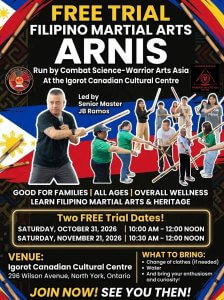
On two Saturday mornings this fall, JB Ramos brought arnis back to Toronto’s Little Manila so families could learn the Philippines’ national sport in their own neighbourhood.
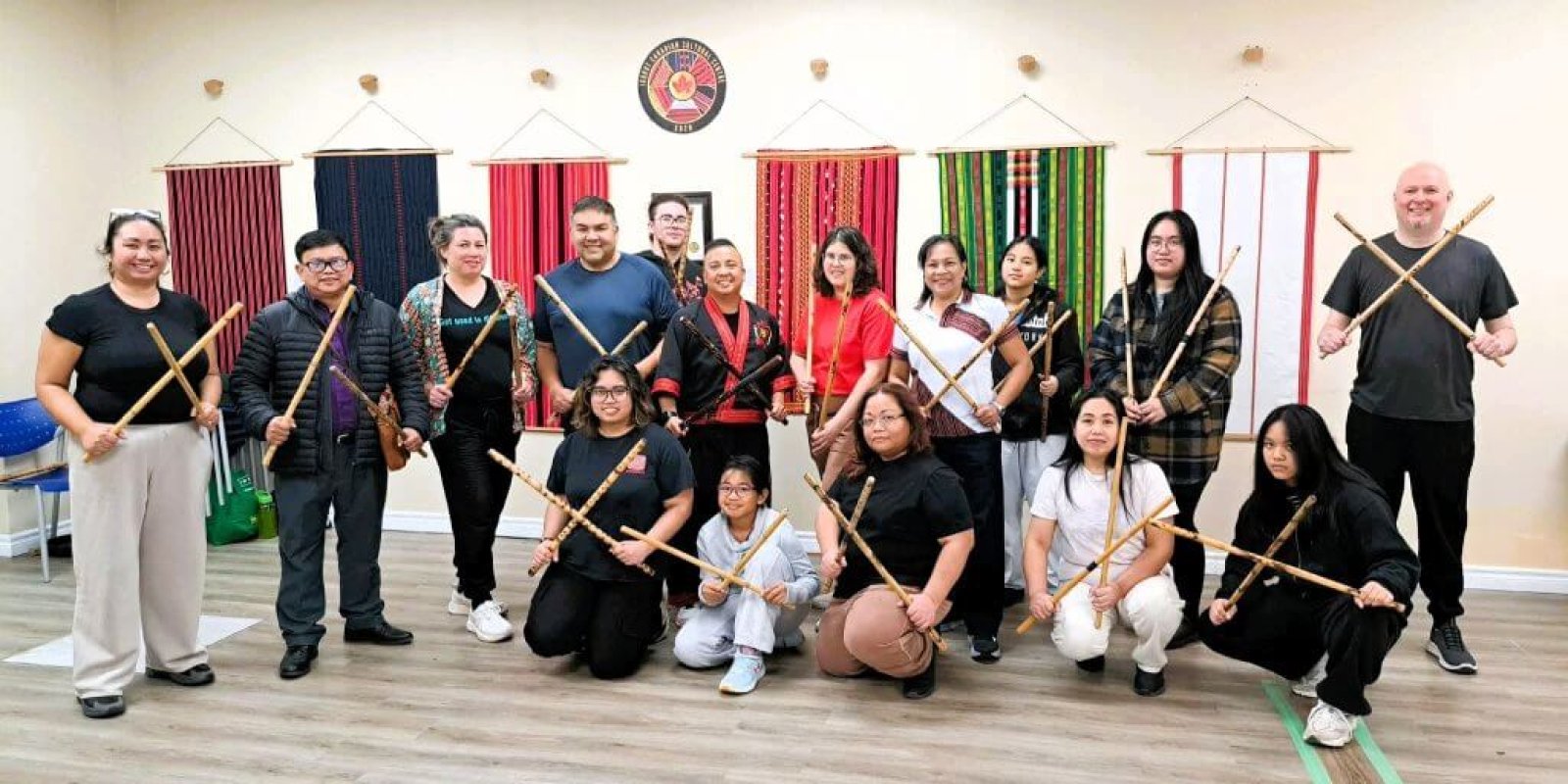
Ramos led two free introductory sessions on Oct. 31 and Nov. 21 at the Igorot Canadian Cultural Centre on Wilson Avenue.
He estimates roughly two decades had passed since residents last had a regular arnis class in the neighbourhood.
For Ramos, who has spent nearly 30 years practising Filipino martial arts, that gap meant a generation of young Filipinos could grow up in Little Manila with few opportunities to pick up an arnis stick.
“I also believe our culture is something we should experience and pass on, not just talk about or celebrate on special occasions,” Ramos said.
“Having the opportunity to teach arnis in Little Manila gives us another way to do that.”
Bringing arnis back to the neighbourhood
Ramos said arnis classes were last offered in Little Manila in the early 2000s.
Although he had no involvement in those sessions, knowing others had taught there shaped how he saw his own role in the neighbourhood.
“In many ways, what we’re doing now is continuing that connection and creating another opportunity for people to experience the art,” he said.
The idea grew out of conversations with his friend Gretchen Mangahas of the Igorot Canadian Cultural Centre.
Through Combat Science, which has been part of his life since 2003, Ramos had taught arnis to people from different backgrounds.
He and Mangahas began discussing how to reach people who might never have had the chance to learn it.
As Ramos prepared the lessons, he thought about what might keep someone from walking through the door.
“I didn’t want anyone to feel that they needed experience or had to be particularly athletic to participate,” he said.
Finding their rhythm
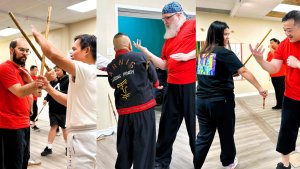
For someone trying arnis for the first time, even knowing where to place their feet requires concentration.
Ramos said beginners are often thinking about where their hands should go while trying to get the timing of their steps right.
He introduced the fundamentals gradually so participants could learn at their own pace.
From the instructor’s side of the room, one of the pleasures of a first lesson is seeing the moment a student stops thinking through every movement.
“You see people go from being unsure of what they’re doing to finding their rhythm and actually having fun with it,” he said.
Diversity in our history
One detail Ramos remembered from the Oct. 31 session was the woven tapestry inside the centre.
It depicted different Filipino ethnic groups, and as he looked at it, he thought about how many distinct traditions people bring with them when they gather in a place like Little Manila.
“We often talk about Filipino culture as though it’s one single identity, but there’s so much diversity in our history, traditions, and communities,” he said.
At the Nov. 21 session, participants also learned about the centre and the cultural traditions of the Igorot peoples of the Philippines.
Some had travelled a considerable distance to attend, according to Ramos.
Ramos said people come to arnis for different reasons.
Some are looking for a connection to their Filipino roots; others are curious about martial arts or want to try a new physical activity.
In his experience, the questions people ask can change as they grow more comfortable with the movements.
“But beyond the physical improvements, I also enjoy seeing people become more curious about the art itself, its history, where it comes from, and what it represents,” he said.
A place to keep learning
After the two introductory sessions, Ramos hopes to give people who tried arnis this fall a regular place to practise in Little Manila.
He would also like to reach families who missed those first classes and young people who have yet to consider trying the sport.
“It would be great to offer more sessions, develop a more consistent schedule, and give people who are interested an opportunity to continue training,” he said.
Combat Science is exploring additional workshops and community partnerships for 2027.
People interested in a future session, as well as organizations looking to host one, can contact the group directly.
For Ramos, teaching on Wilson Avenue began with a conversation between friends.
For someone else, a first encounter with an arnis stick might be the starting point.
“Sometimes we connect with our culture in ways we don’t necessarily expect,” he said.
“It might be through a conversation, a movement, a tradition, or simply sharing an experience with others.”
 Luis Miguel De Castro is a Changing Narratives Fund-Local Journalism Initiative reporter at Mabuhay Canada and a journalism graduate at Humber Polytechnic in Toronto. Originally from the Philippines, he is passionate about community storytelling, multimedia journalism, and amplifying Filipino voices through meaningful local coverage.