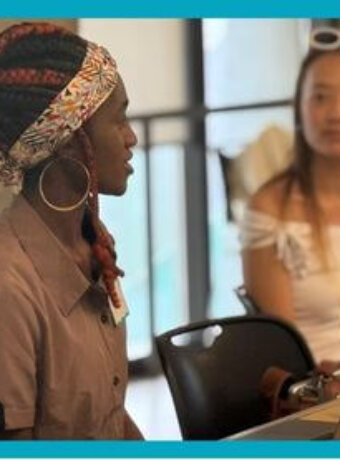
Family reunification and financial pressures can make it harder for some Filipino newcomer youth to pursue post-secondary education, according to a Toronto settlement organization.
Kababayan Multicultural Centre works with Filipino youth who arrive in Canada after years of separation from parents who immigrated first as caregivers or temporary foreign workers.
Executive Director Rizza Solis said reunification can create tension as parents and children rebuild relationships while navigating an unfamiliar country and education system.
“Most of the Filipino youth that we serve are children of caregivers or temporary foreign workers,” Solis said. “They reunite here after several years, and that reunification has a lot of challenges.”
Parents who spent years working in Canada may need to re-establish their roles after their children arrive, she said.
At the same time, young people must adjust to new schools, expectations and responsibilities at home.
“There’s tension between the mother and the father. There’s tension between the children and the parents,” Solis said.
“Sometimes parents expect youth to contribute to household expenses and to contribute by working.”
Those financial expectations can influence whether young people immediately enter the workforce or continue their education, she said.
However, Solis emphasized that no single factor explains the educational choices of Filipino youth.
“It’s not just one factor that’s affecting that,” she said. “It’s a multitude of barriers.”
Recent research continues to examine the issue.
A landmark 2014 study by the Institute for Research on Public Policy found Filipino youth were less likely to earn university degrees than their parents and many other racialized immigrant groups.
Researchers linked the gap to financial hardship, family separation, parents working multiple jobs and limited access to professional role models.
The study also found that many Filipino parents experience downward occupational mobility after arriving in Canada.
That can leave families with less money and parents with less time to support their children’s education.
As a result, some youth enter the workforce to help their families, while others struggle to balance work and school.
A 2024 McMaster University research project on post-secondary attendance among Filipino Canadians described the community as underrepresented in higher education and examined the social and economic factors that may shape students’ educational pathways.
The paper also drew on earlier Canadian research that identified family separation, financial responsibilities and parents’ employment experiences after immigration as possible barriers.
Statistics Canada’s 2026 profile of Filipino populations provides broader context for those family experiences.
More than 957,000 people identified as Filipino in the 2021 census, making Filipinos the fourth-largest racialized population in Canada.
About 71 per cent were immigrants, while 15 per cent of the Filipino population was between the ages of 15 and 24.
The report also found that 43 per cent of Filipino economic immigrants admitted since 1980 entered through the caregiver stream.
Filipino immigrants were admitted through that stream at nearly 33 times the rate of the rest of the immigrant population, reflecting a migration pathway that has often involved parents arriving before their children.
Educational outcomes also differed across generations.
Among Filipinos aged 25 to 54, 46 per cent of first-generation immigrants held a bachelor’s degree or higher, compared with 38 per cent of the second generation.
Statistics Canada noted that second-generation Filipino men were less likely than their immigrant fathers to obtain a university degree.
The figures do not mean Filipino youth are failing to pursue education.
Statistics Canada found that Filipino students often moved successfully from high school into post-secondary studies, although they were underrepresented in graduate and professional programs.
Solis said another barrier is that newcomer families may not understand the Canadian education system or know what financial assistance is available.
“Most of the time, it’s youth who are unaware of how to access post-secondary education, what scholarships are available for them and what financial support is available,” she said.
Kababayan works with schools and families to help young people understand college and university pathways, find financial assistance and connect with community resources.
“That’s where Kababayan comes in to help bridge that gap,” Solis said.
However, the organization’s ability to meet demand has been affected by funding reductions.
Solis said Kababayan previously employed two settlement youth counsellors but had to eliminate one position.
She said cuts affecting settlement workers in schools have also removed support from students who need help navigating education and newcomer services.
Despite those challenges, Solis said culturally responsive guidance can help young people make informed decisions rather than feel pressured to choose between earning money and continuing their education.
“Our main goal is to connect them to post-secondary education and support them in navigating that pathway,” she said.