

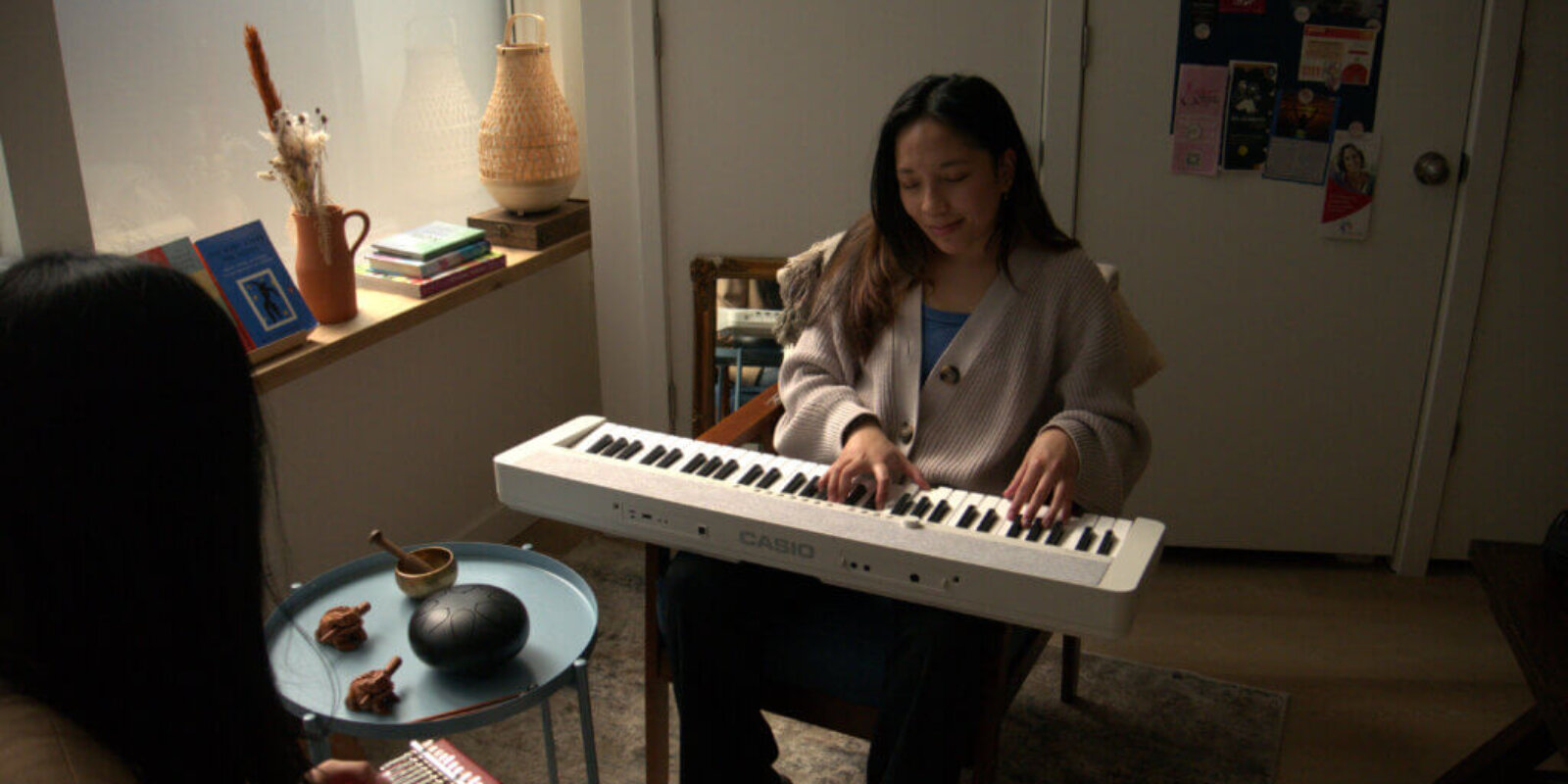
For some people, talking about anxiety, grief or other difficult emotions does not always begin with words.
That is where Kapwa Counselling sees a role for music and art therapy.
The Toronto-based counselling practice offers traditional psychotherapy alongside creative approaches such as music and art therapy, giving clients different ways to express experiences that may be difficult to put into words.
Founder Joanna Gorres said the creative modalities were not part of her original plan when she started Kapwa as a solo practice.
They emerged as the team grew and therapists with different specialties joined.
“It just so happened that I had a music therapist reach out, an art therapist reach out,” Gorres said.
“So we kind of have been exploring this more creative modality more and more.”

Gorres started Kapwa after leaving a career in technology and completing a master’s degree in counselling psychology during the pandemic.
She chose kapwa, a Filipino concept centred on shared identity and interconnectedness, because she wanted the practice to reflect her cultural background and her person-centred approach to therapy.
“For me, Kapwa is really such a beautiful picture of that because we’re not alone,” she said.
“In any struggle, somebody else is going through something similar or the same, and there’s no shame in that.”
The practice now includes therapists working with individuals, couples, families and youth, with music and art providing additional ways to approach mental health.
Finding a way through music
Cynthia Fay, a registered psychotherapist and accredited music therapist at Kapwa, said music therapy can involve songwriting, singing, playing instruments, discussing lyrics or simply listening to a song.
Unlike recreational music-making, however, each activity is connected to a therapeutic goal.
“The difference between just music making and music therapy is we basically use evidence-based practice to get to a specific goal,” Fay said.

For someone experiencing anxiety, Fay may use a singing bowl alongside breathing exercises to help them ground themselves.
Other clients may create playlists designed to help them cope with difficult moods.
Sometimes, a song becomes the starting point for a conversation.
“They say, ‘Oh, this song, this is it. This is how I feel,’” Fay said.
“The music helps them feel the emotion and then start to dig deeper.”
Fay’s connection to music therapy is also personal.
Growing up half Filipino in Canada, she remembers her grandfather picking her and her brother up from school before spending afternoons singing karaoke together.
Years later, when her grandfather developed dementia and could no longer recognize his family, music provided another way to reach him.
“I played some music for him and, lo and behold, all the lyrics came back and he was able to sing,” Fay said.
“It was still a way for us to meet in the middle.”
Expressing emotions through art
Kapwa applies a similar idea through art therapy.
Gorres said art can give clients something tangible to work with when experiences such as grief are difficult to discuss.
Activities can include creating collages and other forms of visual expression with the guidance of a trained therapist.
“Sometimes people don’t have the words, but we are given this gift of art and that helps people express that,” she said.
Clients can also combine approaches.
Gorres said some families work with her through talk therapy while individual family members see another Kapwa therapist for music, art or individual psychotherapy.
For Gorres, offering different approaches is also part of making therapy responsive to the person rather than expecting every client to communicate in the same way.
Breaking barriers to mental health care
In a practice where many clients are immigrants, children of immigrants or people navigating intergenerational family dynamics, it is particularly important to break barriers to mental health care.
Gorres said stigma, cost and language remain barriers for Filipino Canadians seeking mental health care.
As a Tagalog-speaking therapist, she has also seen how difficult it can be for some clients to describe deeply personal experiences in a second language.
Creative therapy, however, comes with misconceptions of its own.
Fay said clients sometimes assume they need to know how to sing or play an instrument before trying music therapy.
“You don’t have to be a skilled singer. You don’t have to be somebody that plays any instruments at all,” she said.
Gorres makes a similar distinction between activities that feel therapeutic and professional therapy.
“Music is my therapy. Art is my therapy. I get it,” she said.
“All of these things are therapeutic, but not all of them are actual therapy.”
For Kapwa, the difference is having a trained practitioner help clients use those creative tools with purpose, whether the first step is talking about a problem, putting it on a canvas or finding it in a song.
 Luis Miguel De Castro is a Changing Narratives Fund-Local Journalism Initiative reporter at Mabuhay Canada and a journalism graduate at Humber Polytechnic in Toronto. Originally from the Philippines, he is passionate about community storytelling, multimedia journalism, and amplifying Filipino voices through meaningful local coverage.


